Which data may be processed? And
when is caution required? Data protection law
plays a central role in the everyday life of many companies.
With iust.ai you receive an understandable
initial classification without technical jargon or
complex research.
Data protection law regulates how
personal data may be collected, processed and
used. It creates the legal
framework so that information about people
is not used arbitrarily, but is processed transparently,
for specified purposes and securely.
At the same time, it strengthens the rights of those affected,
such as to information, correction or deletion
of their data.
In everyday life, however, this often leads to uncertainty.
Many questions only arise when data
has already been collected or concrete questions
arise: Which data is really
required? On what legal basis may
processing take place? How are information or
deletion requests to be answered correctly?
And
what obligations exist when
personal data is accidentally
disclosed? Especially for self-employed people,
start-ups and medium-sized companies,
data protection law is difficult to grasp.
Regulations such as the GDPR seem extensive
and technical, while practical
guidance is lacking.
iust.ai helps to classify these requirements in an understandable way
and to break them down into typical questions.
This way you get practical
orientation and can identify data protection risks
early and avoid them.
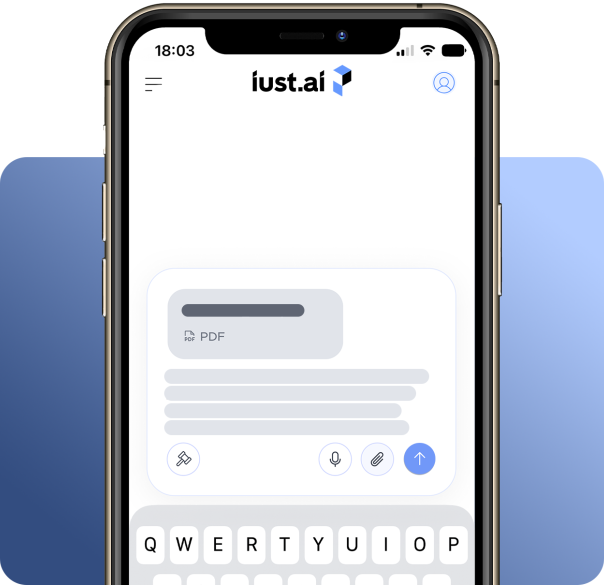
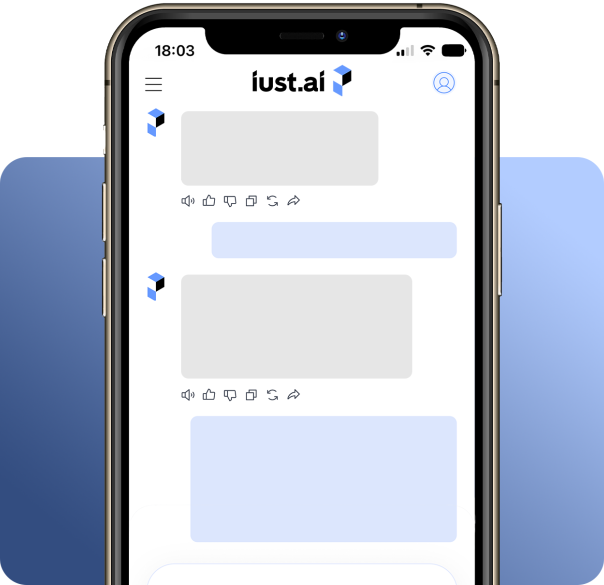
Simply
Ask your question as it comes up in everyday life
– no prior knowledge needed. iust.ai explains clearly what matters.
Checked
The content is based on current legal
foundations and is regularly reviewed to provide good orientation.
secure
Your data will be treated confidentially and processed on servers in Germany - in compliance with applicable data protection regulations.
Use cases
The most common Use cases
Legal questions often arise under time pressure. iust.ai
supports you in data protection law as well as in
other areas of law:
Check employment contract
Unsure whether all the clauses in your employment contract
are legal? iust.ai helps with quick
orientation.
Do you have any questions about data protection law or the use of iust.ai? We have the answers:
Data protection law regulates the handling of
personal data and is intended to ensure,
that information about people is processed lawfully,
transparently and for specified purposes.
At the same time, it strengthens the rights of
those affected, such as to information, correction and deletion of their data.
The General Data Protection Regulation of the
European Union (GDPR) applies to all
companies, self-employed persons and
organizations that process personal data,
as soon as there is a connection to the European
Union. It does not matter how
big the company is or where it is based.
Consent is necessary if there is no other
legal basis for the processing.
It must be given voluntarily, be clearly
understandable and can be revoked by the affected
person at any time.
The central data protection principles include
lawfulness and transparency, purpose limitation,
data minimization, accuracy as well as
storage limitation and data security. They
form the basis for any permissible
processing of personal data.
No. iust.ai is not a law firm and does not replace
a lawyer. It is an AI platform that provides
structured legal information based on
national laws. All content is
automatically generated and provided "as is"
– iust.ai does not guarantee legal
accuracy or case validity.
Absolutely. iust.ai complies with the Swiss
Data Protection Act (DSG) and the EU
General Data Protection Regulation (GDPR).
Your data will be:
encrypted and stored securely
never shared without your consent
only accessible to authorized personnel or service providers